Bed slinger vs CoreXY: what's the real difference?
Bed slinger or CoreXY? On a bed slinger the whole bed (and your print) is the Y axis. A CoreXY keeps its bed still in X and Y and moves only a light toolhead, driven by two motors that never ride along.
What you'll learn
- Small parts, tinkering: slinger
- Tall parts, speed: CoreXY
- Either one: tune acceleration
Chapters
- 0:00Two ways to move
- 0:23The bed slinger
- 0:38Mass and ringing
- 1:10CoreXY
- 2:00The trade-offs
- 2:23Tame the shake
- 3:03Recap
Pause and guess
Only motor A turns. B stays still. Where does the head go? (tap to see the answer)
- Along X
- Along Y
- Diagonally
Print settings
| Quality | |
|---|---|
| Layer height | 0.20 mm |
| Strength | |
| Wall loops | 2 |
| Sparse infill density | 15 % |
| Speed | |
| Outer wall accelerationkey setting | printer default, then half |
| Support | |
| Enable support | Off |
Grouped by the tabs in Bambu Studio. Names differ slightly in PrusaSlicer and Cura. Settings not listed can stay at your printer profile.
Test it yourself
Mentioned in this episode
Full transcript
Some 3D printers fling the whole bed back and forth. Others keep the bed still, and fly the toolhead around in a box. Bed slinger or CoreXY: what's the real difference?
Here's where you see it. Print a tall, thin part fast, and you may get ripples right after the corners, or a wobbly top. Part of the cause is how much mass your printer has to move. Let's compare both machines, and tame the shake on either one.
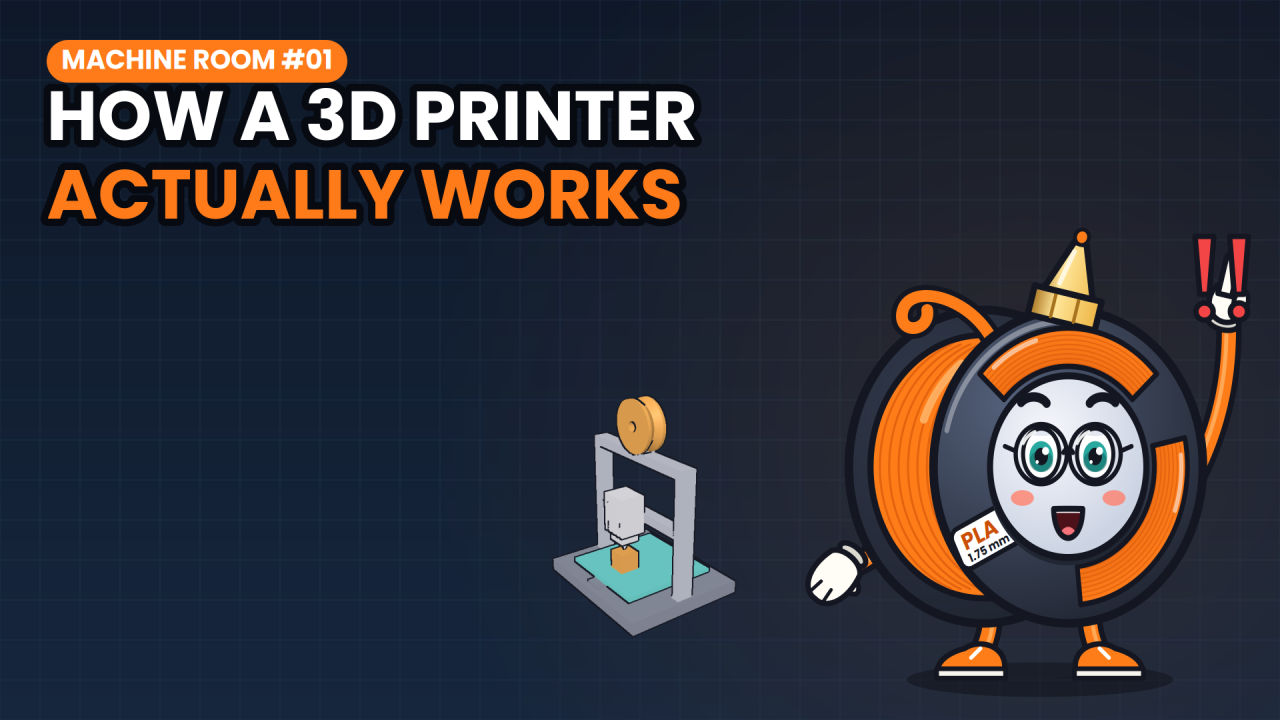
In Machine Room number one, we followed the filament through a bed slinger. Quick reminder: the toolhead slides left and right, that's X. The whole bed slides back and forth, that's Y.
Your print rides along. Every Y move pushes it forward, stops it, and throws it back.
Why does that matter? Every move has to start and stop, and force is mass times acceleration. Twice the mass needs twice the force to speed up just as hard.
And a bed is heavy. A 235 millimeter aluminium plate, 3 millimeters thick, weighs about 450 grams on its own. Add the carriage, the build sheet, and your print, which gets heavier with every layer.
When that weight stops, the frame and belts spring back a tiny bit. The nozzle draws that wobble into the wall: ripples right after each corner. Makers call it ringing, or ghosting.
Now the CoreXY. Here the bed never moves in X or Y. It only goes down, one layer at a time. The toolhead does all the fast moves, riding on a light gantry beam.
And here's the clever bit. Both motors sit still on the frame, and pull two long belts. Turn both the same way, and the head moves along X. Turn them opposite, and it moves along Y.
Pause and guess. What if only motor A turns, and B stays still? A: the head moves along X. B: along Y. Or C: diagonally?
It's C. Diagonally, at 45 degrees. Neither motor owns an axis. Every straight X or Y move needs both of them.
So the motors stay put, and so does the bed. Only the toolhead and a light beam move fast. Less moving mass, so a CoreXY can usually accelerate harder, with less ringing.
Not a clean win, though. A bed slinger's 235 millimeter bed sweeps through about 470 millimeters, front to back. A CoreXY is a box, just around its bed.
CoreXY pays with complexity: two long belts that need even tension, and a frame that must be square. A bed slinger is simpler to build and to fix. But a CoreXY is already a box, so it's easier to enclose.
Whatever you own, the shake can be tamed. Many printers now run input shaping: the firmware knows how the frame wobbles, and shapes each move to cancel it.
In your slicer, lower the outer wall acceleration, say to half. Only the visible walls get gentler, so you lose far less time than by slowing the whole print.
See it on your own printer: print this free tower. Each wall has two small notches. Shine a light along the wall right after each one. Then lower the acceleration, print again, and compare.
So which one fits you? Mostly small parts, and you like to tinker? A bed slinger does the job well. Tall parts and lots of speed? CoreXY earns its extra belts. Either way, tune the acceleration.
In short: on a bed slinger, the bed is the Y axis. A CoreXY keeps its motors still and moves a light head. Less moving mass usually means less ringing.
The ringing tower is free, link in the description. Tell me in the comments: do you run a bed slinger or a CoreXY, and would you switch? Next time in the Machine Room: open frame or enclosure. Subscribe so you catch it. I'm Spoolbert, see you in the next one.

Spoolbert explains one 3D printing problem per episode, with a free model to test the fix. Made by EMBODY³, a 3D printing studio in Belgium.